
Every Seller Becomes a Manager. Every Sales Manager Becomes a Coach.
What AI really does to the shape of a go-to-market team
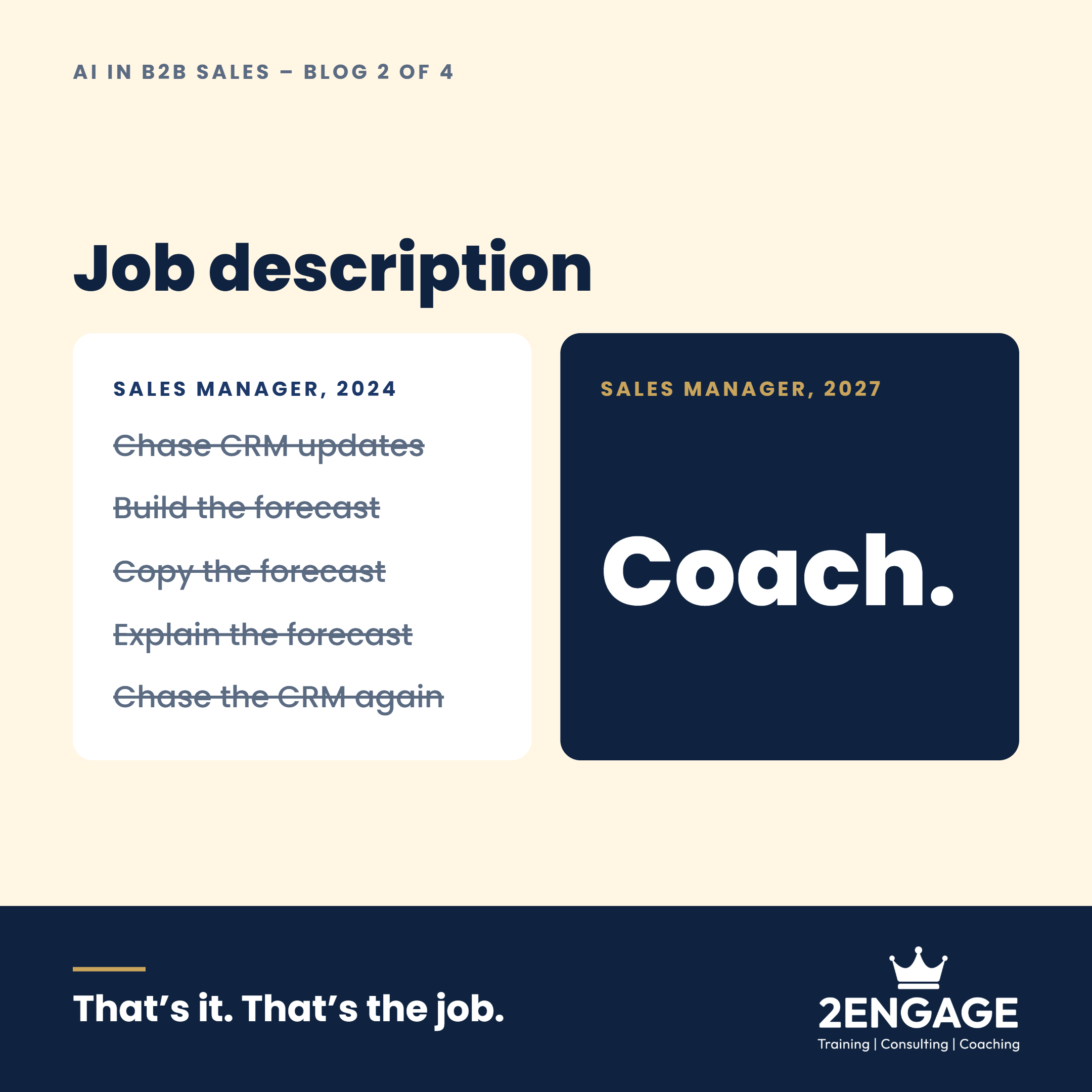
Look at the week of a typical sales manager. Monday: chase CRM updates. Tuesday: build the forecast from what the reps say. Wednesday: copy it into the VP’s template. Thursday: answer the VP’s questions about it. Friday: chase the CRM again. Somewhere in between, if there is time, one real coaching conversation.
That is not management. That is middleware: a human cable between the reps and leadership. AI is about to make that job disappear. At the same time, something bigger happens one level down: every seller becomes a manager.. of agents. Both shifts change the shape of your go-to-market team, and I think both are good news.
Everyone is asking the wrong question
Most AI debates in sales start with headcount. How many SDRs do we still need? Can one AE now cover twice the territory? Wrong starting point. Start with: what work actually creates value, for the buyer and for us? Walk the buying journey backwards. What does a buying group of a dozen people need to reach a confident decision? Then decide, piece by piece, who or what does that work.
Teams that start with headcount cut cost and keep the bottlenecks. Teams that start with value redesign the work. Only the second group gets faster.
Role compression is really role expansion
I expect roles to merge. In some segments the SDR and AE roles will fold into one, with agents doing the research and sequencing and one person owning the customer from first conversation to signature. For mid-complexity deals, AEs will build tailored demos and business cases with AI that used to need a presales engineer. Marketing and SDR teams will meet around the same buying signals.
The point is not fewer people doing less. It is fewer handoffs, and people owning more of the whole job. Handoffs are where deals go to die: the buyer telling the same story for the third time, to the third new face. Fewer handoffs means broader skills, and a compensation plan that rewards them.
Your sellers are managers now
Here is the part almost nobody prepares for. Every individual seller will soon manage a small team: a research agent, a notes agent, a follow-up agent, maybe a proposal agent.
Managing agents is a real skill. Brief them clearly. Check their work. Know when to override. Update them when your offering or pricing changes. Most sellers have never managed anyone. If you don’t train it, they will either trust the agents blindly or ignore them completely. Both are expensive.
From middleware to coach
When AI handles pipeline inspection, activity reports and the forecast roll-up, the manager gets time back for the things that actually move numbers. Deal coaching. Call coaching. Removing obstacles. Helping a rep make a hard trade-off. Coaches, not measurers.
One warning. Don’t use that freed time to stretch spans to one manager for 25 reps because “the dashboard does the managing now”. You will book the cost saving and lose the coaching. A manager’s value sits in conversations, and conversations don’t scale like dashboards.
Smaller teams, bigger bets
The most exciting shape I see is the small pod. An AE, a presales lead and a customer success manager, supported by agents, fully owning a set of strategic accounts or a new market. The smallest team that can own the whole outcome.
Pods work best on new problems: a new segment, a new offering, a new route to market. For tuning the engine you already have, they are overkill.
Please don’t draw the 2030 org chart
The temptation is a big redesign: one consultant-built future org chart, rolled out top-down. Don’t. Nobody knows what the right shape will be in three years, and AI changes too fast for a fixed blueprint.
Let the willing go first. Every sales organisation has a team that is already experimenting. Give them the tools, the freedom and a clear value target. Let them redesign their own work, then spread what works. Show, don’t slide.
Call to action for sales leaders
- Audit one manager’s calendar. Count the hours spent relaying versus coaching. Automate the relaying first.
- Train sellers to manage agents: briefing, reviewing, overriding. The way you once trained them to manage a territory.
- Pick one willing team as your first pod. Measure outcomes, not activity.
The sales organisation of the future is not flatter or smaller by definition. It is built around value instead of reporting lines. Managers become coaches. Sellers become managers. And the people who make that shift will be worth more than ever.
Go deeper. Coaching deals and owning strategic accounts as a small team both need a shared language. You’ll find it in my 2ENGAGE Training Catalogue: Deal qualification & progression – inspired by MEDDPICC and Account Planning for growth and long-term customer value.