
Your AI Sales Tool Is a Commodity. Your Context Is the Only Moat.
Why the tool won’t make the difference, and what will
Your competitor bought the same AI model you did. Probably the same sales tool on top of it too. So tell me: where exactly is your advantage?
Pilots lie
Every AI pilot in sales looks great. Ten hand-picked reps, a motivated sponsor, clean accounts and a vendor engineer on speed dial. Then you scale to 300 sellers, messy CRM data and real customers, and the magic fades.
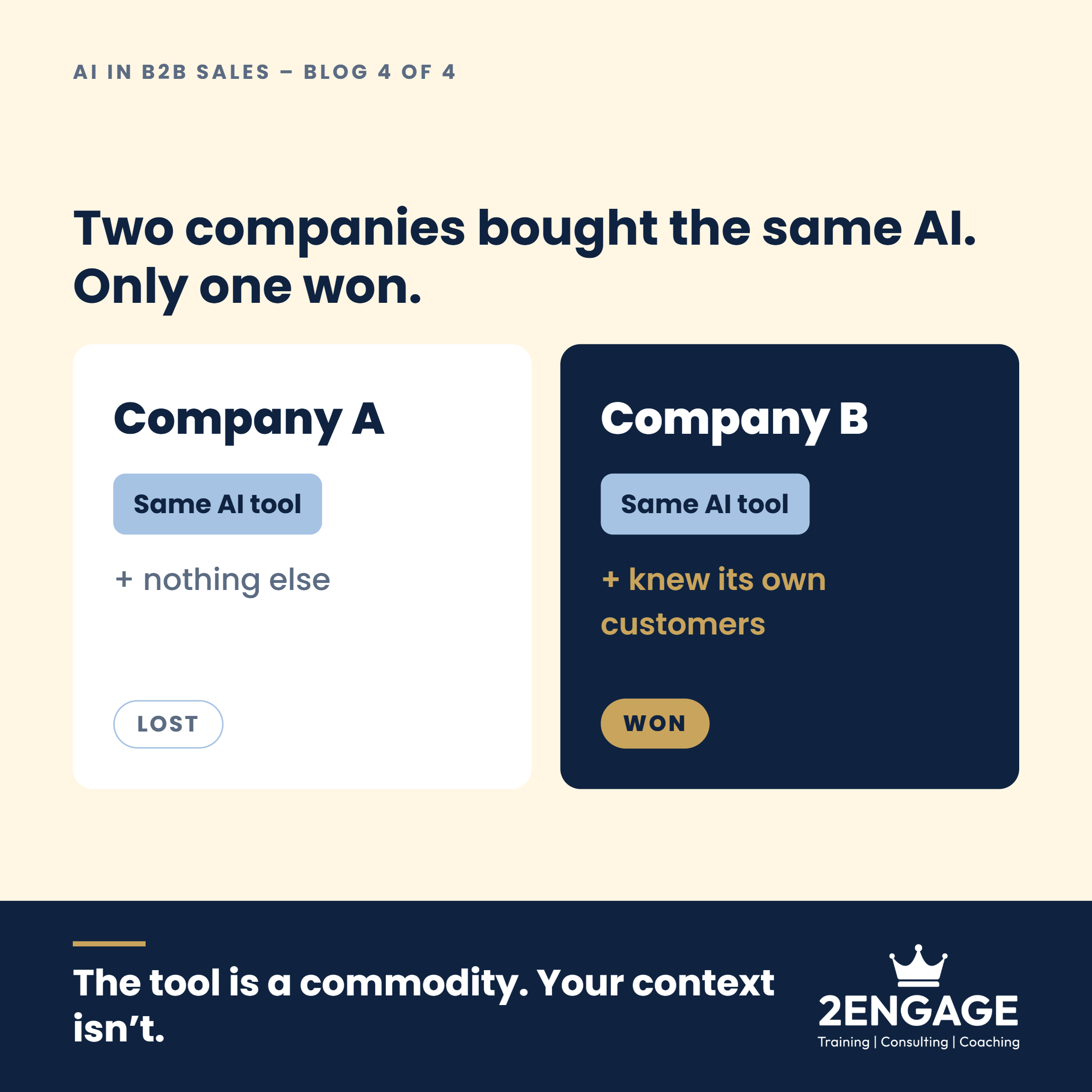
MIT’s Project NANDA put a number on it in The GenAI Divide (2025): around 95% of enterprise generative AI pilots showed no measurable impact on the P&L. The main cause was not the quality of the models. It was how poorly the AI was built into real processes, and how little the organisation learned along the way. In plain words: the tool was fine. The context wasn’t!
Context is the moat
A model knows the internet. It does not know:
- your ideal customer, and why your best customers really bought
- your value stories and proof points
- your discount rules, and what Legal will never sign
- your win/loss history
- what “qualified” means in your MEDDPICC
- which discovery questions unlock a deal in your market
That is your context. Feed an agent your context and it starts to sound like your best seller. Feed it nothing and it sounds like everyone else’s AI. Context also makes AI cheaper. An agent with precise instructions guesses less, retries less and needs fewer tokens to get it right. Dumping the whole CRM and every slide on SharePoint into it is not context. It is noise you pay for.
Here is the twist I find most interesting. For years the sales playbook was shelfware: nice to have, rarely opened. Now your playbook becomes the operating system for your agents. A vague playbook gives you vague AI, at scale.
Spend on the foundations, not the licences
My rule of thumb: for every euro you spend on AI licences, plan at least two on the foundations. Clean data, a sales methodology and processes that are written down. Most budgets are the other way around. That’s why so many AI rollouts end up as expensive experiments that never scale.
Watch the cost per outcome, not the cost per message
AI looks cheap per message, but the price of a message says nothing about the price of a qualified opportunity. Agents that loop, retry and research the same account five times quietly burn budget, and usage-based pricing means the bill grows with every ambitious idea.
So measure what an AI-sourced qualified meeting really costs, all-in. You may be surprised in both directions.
Bet narrowly
The weakest AI strategy in sales: thirty copilots, each saving someone ten minutes a day. It feels busy, but it moves nothing.
Pick one or two bets tied to how you win: discovery quality, deal qualification, growth in existing accounts. Fund them properly. Build them on a shared (process) context layer, so the next use case starts from 60% done instead of zero.
Then measure what matters. Not emails sent, but outcomes: time from first meeting to decision, win rate, and the deals you lose to “no decision”. Dixon and McKenna found that 40 to 60% of B2B deals end in no decision. An AI programme that doesn’t move that number is just a productivity toy.
Sales leaders, this is your project
If AI in go-to-market is “IT’s project”, you will get a tool. If it is yours, you can get an advantage. Only sales leaders know the context: the customer, the value, the rules of the deal. That makes them the only people who can make AI sell like their company.
Call to action for sales leaders
- Write down your context before you buy another tool: ideal customer, value stories, qualification criteria, pricing rules, best discovery questions.
- Pick one or two bets tied to how you win, and stop the rest.
- Measure cost and value per outcome: per qualified opportunity, per decision. Never per message.
The model is the same for everyone. The way you sell is not. Don’t lead with the tool. Lead with the way you win.
Go deeper. Your context starts with knowing why customers buy and what value you really create. Two trainings in my 2ENGAGE Training Catalogue cover exactly that: Acquire customers by creating business value and Strategic questioning to uncover true buying drivers