How smarter targeting and qualification will boost your conversion rates.
All Tech Vendors are looking to improve conversion & win rates. But strangely enough, for targeting accounts, the majority defines their Ideal Customer Profiles (ICPs) in a very simple manner, and they only do that once or twice a year.
With the rapid pace of market & technology changes, ICPs need to be examined and updated accordingly. What worked in the past, might not work anymore today, or in the near future. ICPs simply based on firmographics, such as industry, size and geography, is insufficient to really understand the motivations of the target buyer.
Gartner’s enterprise attributes are popular, that can help to detect patterns of the target organizations that you want to go after.
- Technographics looks at the mix of technologies that are used by the organization.
- Business situations is about situational elements that could apply such as years in business, profitability or acquisitions.
- Business and operating models explore how the organization operates such as the usage of certain ecosystem or pricing models
- Psychographics looks at how organizations act and think about technology purchases
- Resources look at resource considerations within the organization such as number of data analysts or developers.
For ICPs you look at: “what do they have in common? And where are they different?” It’s important that you add relevant details to deepen your understanding of your buyers, resulting in sharper and more effective marketing and sales efforts.
There are sales teams thinking “that’s a lot of extra work, can’t marketing do that once a year?” Well, if you get an ICP refinement for your territory right, it will help you to better prioritize your sales efforts, improve your deal qualification, and by that, improve your win rates. So, effective targeting helps to generate more leads. Now let’s dive into a modern way handling those leads.
You are probably familiar with the traditional metrics of Marketing Qualified Lead (MQL) and Sales Qualified Lead (SQL), which is then followed by a Sales Accepted Lead. Below a representation of the old world. What’s wrong with the old world? Well, if you think about it. It’s not a single contact who’s buying from you. It’s an enterprise with a buying group who will select the vendor-of-choice and decides to purchase.
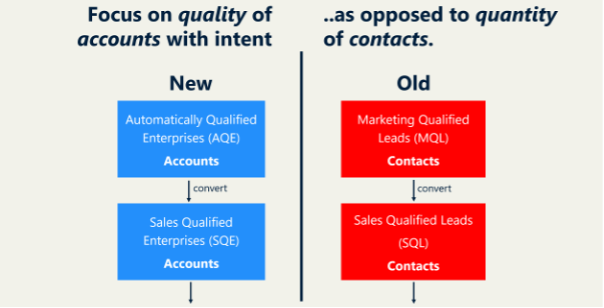
Furthermore, although it’s called Marketing Qualified Lead, Marketing often doesn’t qualify anything, this is done purely automatically. That’s why Marketing Qualified Leads can better be replaced by Automatically Qualified Enterprises (AQE). Enterprises mean Accounts that consist of multiple persons that should be researched and contacted. Moving from a single contact to an enterprise-level, reflects much better how your buyers actually behave.
In addition, there is only an automatic qualification if the account complies to the predefined ICP. Enterprises buy from you when their buying “intent” is high. That’s where third-party intent data or AI platforms like Evergrowth can help you out. It will tell you exactly who is searching online for the products that you are selling. So, you need to focus on the quality of accounts, as opposed to the quantity of contacts. In modern sales you should convert Automatically Qualified Enterprise into Sales Qualified Enterprises.
Warning: do not make the mistake to consider Marketing owning the metric of AQE, where Sales owns the metric for SQE. Today, it is impossible to differentiate between the impact of Marketing and Sales on a purchase decision. That’s why you all need to use joint targets: all go-to-market roles are in the same boat. You all fail, or you all succeed!
These metrics and ownership are critical for successful end-to-end revenue production.
Call to action for sellers:
- If you want to improve win rates in your territory, then you need to use an Ideal Customer Profile and refine it regularly.
- For better qualification, stop focussing on the quantity of contacts, and start focussing on the quality of accounts with an intent to buy – what you sell.
- Stop distinguishing marketing and sales KPIs. Joint metrics and ownership are critical for successful end-to-end revenue production.