

How to uncover the real customer problem to increase win rates.
Discoveries are critical to understanding the customer’s needs, to build rapport, and to establish confidence in your solutions. At this stage you need to keep in mind that businesspeople prefer a conversation over a presentation.
And questions are known to get any conversation started. But, you only have very limited time that customers spend with you, so how to balance your time. As a salesperson, you want to show what you have to offer, which easily ends-up in “selling to” and an “information overload” for the prospect.
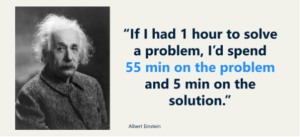
Albert Einstein said once that if he had to solve a problem, he would spend 55 minutes on the problem, and only 5 on the solution. Very recent sales research supports his claim. When you can accurately identify your buyer’s problem during discovery calls, it boosts your buyer’s confidence in your solution, and you win more deals.
However, the sad reality is that sellers only get the customer’s problem statement right less than half the time, according to a study by the Florida State University Sales Institute. Buyer’s feedback shows that the biggest misstep sellers make when they lose a deal is poor needs-discovery and a lack of alignment between their solution and the real problem.
This also shows that the discovery stage is where you can start to differentiate yourself from competition by active listening, and by understanding the business problem as perceived by the buying team. Understanding the business problem requires a lot of questions. Questions about background, decisions, problem scoping, solution scoping, solution clarification, and so forth.
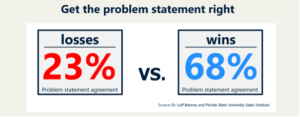
From analyzing the losses, only 23% of the vendors had the problem statement right while of the winning vendors, 68% got the problem statement right (source: Dr. Leff Bonney and Florida State University Sales Institute). These figures show how important it is –like Einstein said- to take enough time for the problem, to ask the right discovery questions, to identify and clarify the customer’s problem statement. Now if this is not already hard enough, here is another result of research that’s highly relevant for you.

Even if buyers seem confident that they know exactly what their problems are, they change their problem statement on average 3.1 times during the buying journey for complex purchase decisions (source: Dr. Leff Bonney). This is partly because of the diversity of the buying group, and their attempts to create consensus about the real problems and the related purchase goals.
For you, this means that using the right problem and solution clarity questions can make the difference between winning and losing. There is also a methodology that can help to check the correctness with your customer, it’s called the GOAL methodology.
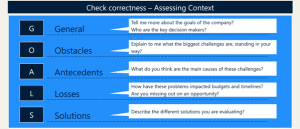
Every letter from GOAL represents an important area of the context of a problem statement. All this sounds simple, but in practice it is not always easy to ask effective discovery questions.
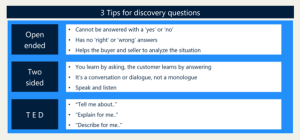
So here are 3 tips – how you can ask your questions in such a way that the answers are much more valuable to you.
- Ask open-ended questions that cannot be answered with just a yes or no. Let them speak instead of yourself.
- Make sure it’s not a monologue but a two-sided Listen actively and ask deeper questions about what you have heard
- Apply TED: T of Tell me more about the issue you recently faced, E of Explain for me pls what you exactly mean with.., D of Describe for me what type of … you exactly mean.
Call to action for sellers:
- To belong to the 45% that gets the customer problem statement right, you need to spend more time on discovering the problem instead of pitching your solution.
- Even when you think you’ve got it right, buying teams change the problem on average more than 3 times so don’t forget to ask your problem & solution clarity questions
- Use the TED technique in discoveries: Tell me, Explain for me, Describe for me. You will be surprised what a difference this can make.