What happens when you follow the buyer’s journey instead? Sell less, win more.
Do you want to be sold-to? B2B buyers neither. Instead of focusing inside-out on your own sales journey, you need to focus outside-in on the customer buying journey.
In this example, there are 5 stages of a customer buying journey, derived from an industry standard of SiriusDecisions. The customer journey evolves from creating awareness where prospects consider changing a certain business situation, towards educating themselves about the topic – mostly online, this is also where you’ll help the customer identify their problem statement. This is followed by the decision about what solution and vendor to go with, followed by an implementation stage. Lastly, a stage considering to stay, extend or leave. It’s all about customer loyalty.
The actual customer buying journey is not a linear process from left till right. There are also moments that buyers go 1 or 2 stages backwards. As explained in the earlier blog, all stages need support of integrated customer engagements: the hybrid model of digital and human interactions.
But what type of interactions are that, and by whom? Below you see an example of a real customer buying journey with both digital and human touchpoints. Depending on the customer buying journey stage, digital assets are offered to help buyers to make the right decisions in favor of you.
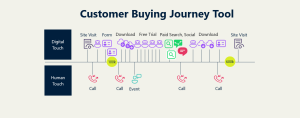
The different assets can be used by SDRs, Sales, presales, partner managers, PS or CSMs. Across the entire buying journey, it is the collaboration between all those roles, using the right assets at the right time, that will determine your success in winning new logos, retaining and evolving existing customers.
There is one other thing: it is a myth to think that your customer only takes one decision: choosing you or competition. The customer’s buying group makes decisions in every single stage of the journey and it is up to you the help them best. What do I mean by that?
In the Awareness stage, the customer need to make a decision if there is a reason to change. So, your messaging needs to focus on answering the question “Why change and why now?” And although you act buyer-centric, you need to keep your own objectives in mind, which is to acquire your audience by engaging in their experienced pain. In the Education stage you help answering “How to change” in order to create an opportunity out of the situation. In the Decision stage the customer needs to justify the purchase & purchase amount. You will help them to achieve that, with your tailored business value proposition written in their narrative. Then, the decision is made on the Implementation. It’s crucial that the buying and implementation experience is good, to avoid any purchase regret. The last stage of Loyalty is all about decisions to stay, evolve, or leave.
Now remember, you want to achieve a successful, buyer-centric approach. For that, you need an excellent end-to-end alignment between your revenue generating roles. With such a customer engagement framework, all go-to-market roles have the same understanding of the stages, of the metrics and the vocabulary, because it helps if you all have the same understanding about what for example is meant by a Champion, a Metric, or an Economic Buyer.
That’s where deal qualification methods come into the game, such as MEDDPICC. If you have all of this in place, you can jointly ‘always be qualifying’ and jointly progressing your deals by finding the right answers to the MEDDPICC questions together with the customer.
Because buyers also need the answers to the MEDDPICC questions, to progress their purchase. So, this is a true win-win situation. Besides MEDDPICC, there are more supportive tools. One of them is account-based, real-time measurement of the customer buying journey, also called: the customer buying journey tool (CBJT). Based on the CRM system and multiple other sources, customer interactions are chronologically represented in a journey. Where MEDDPICC shines a light on the way forward, a CBJT paints a picture about what already happened in the past.
Forrester analyzed how customer buying journeys changed over the last years. They found that if you split customer interactions into digital versus human touchpoints, and then compare the data, there is a big change going on. The frequency of interactions has increased between 8-10x. The vast majority of touchpoints is digital. This really accelerated during and after the pandemic.
Buyers have changed permanently. They don’t want to be sold-to. Instead, they prefer to do their own research. But very often, customers are too narrowly focused on what they WANT. But that is not what they NEED to solve their pain. By engaging with sales reps, the customer can be challenged to reframe their thinking in terms of what they really NEED. In addition, most purchase regret is when there is no interaction with a salesperson. So, interactions between sales and buying groups still matter!
Call to action for sellers:
- Across the entire buying journey, it is the collaboration between all the GtM roles, using the right assets at the right time, that will determine your success in winning new logos, retaining and evolving existing customers.
- Make sure you have the same understanding of the buyer stages, of the metrics and the vocabulary. Always be jointly qualifying with MEDDPICC to use the available resources in the right manner for success.
- MEDDPICC helps forward looking, where the customer buying journey helps looking at the past to provide relevant context.