

Why go-to-market alignment is your biggest growth lever.
79% of B2B tech companies struggle with end-to-end alignment among revenue-generating teams, according to Gartner’s Tech CEO Customer Acquisition Survey. Think about the silo’s between Marketing –SDRs – Sales – Customer Success. So “8 out of 10 companies in your industry know that they should, but they don’t know how to achieve that E2E alignment”.
Introducing those joint metrics of Qualified Enterprises helps (see my earlier blog), but in addition, you do need to break-down the traditional silo’s. To achieve alignment in end-to-end revenue production: what is it exactly that you need to change?
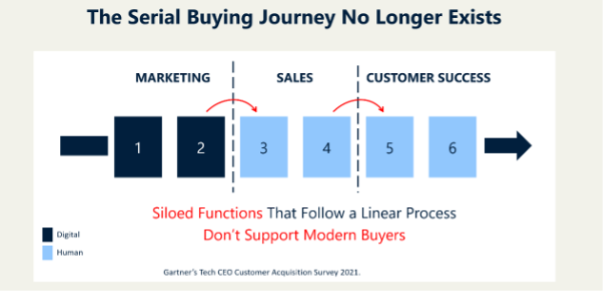
First, the traditional, serial process from 1 to the other silo should no longer exist, because, that serial approach of siloed functions following a linear process, does not support a modern customer buying process anymore. Customers’ buying behavior has changed, so you -as a seller- need to change as well. And that requires a more flexible approach by a collaboration between the go-to-market roles
Almost half of all buyers desire a seller-free sales experience, they do not want to be sold-to, they want to be helped with their buying decisions in their buying journey. That means that this inside-out, sales-driven approach must be replaced by a more outside-in approach of you, and your ecosystem, supporting the buying journey. If you help buyers to buy best, they will end up partnering with you. That’s why in every customer engagement framework, the starting point should not be the sales journey, but the buying journey.
And what about the balance between digital and human interactions with customers? We all agree that this design is ‘setup for failure’: starting with digital marketing activities generating leads, throwing over the fence for human sales activities closing the deal, so that they can throw a contract over the fence for mainly human customer engagements by Professional Services and CSMs.
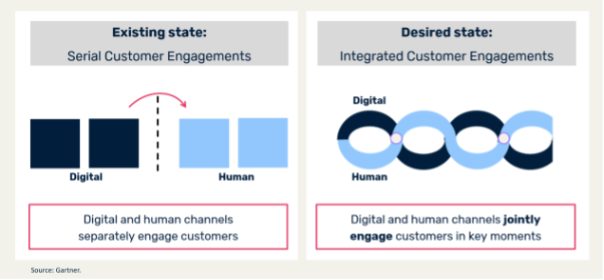
Gartner says that tech vendors must avoid an “either/or” go-to-market mindset when it comes to digital and human customer engagements. Avoid the traditional sales model that relies separately engaging customers: either all-digital marketing activities, or just on human sales activities. Their research found that the most successful approach is hybrid when digital and human channels jointly engage customers in key moments of the customer journey – to help buyers to buy (from you).
To do this effectively, you need to have insight into your customer’s journey, that’s where again – third party intent data can help you. Now let’s take this further, combining the modern customer buying journey with the desired integrated customer engagements.
Call to action for sellers:
- Following a linear process does not support a modern customer buying process anymore, break down the traditional silo’s.
- If you help buyers to buy best, they will end up partnering with you. Do not focus on the sales journey, but on the buying journey.
- Instead of the old, serial approach from Digital Marketing to Human Sales, rely on an integrated approach of digital and human activities hand-in-hand along the entire customer buying journey.