Buying is a Team Sport: what Sales gets wrong about buying groups.
In earlier blogs I wrote about “buying groups”. In reality, there is a whole world behind that. Let’s dive into that and touch base on how you can influence them.
If you want to effectively influence buying groups, you first need to better understand:
- how they spend their time
- who they are, and
- what to focus on.
A recent Gartner survey discovered something provocative, that started before the pandemic and only increased further through the pandemic, and that is the amount of time that buyers spent with vendors. What do you think, do they spend 50%, 40%, or maybe 30% of their time with vendors? The answer is only 17%! Buyers only spend 17% of their buy-sequence with vendors.
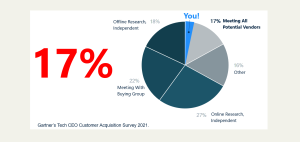
BTW that is not only you exclusively, that’s you and your competition. So, if there are 4 vendors selling, you only get 4% of the cycle time, if you could make it ‘at all’ to the short list. This is very problematic.
There are only a few ‘moments of truth’ where you as a seller can spend time with a customer. Why is that? Well, almost half of all buyers desire a “seller-free” sales experience. A preference that climbs to 54% for millennials. This has everything to do with the fact that buyers educate themselves online, about products and solutions, they don’t need a sales rep for that.
You can see the break-down of time spent by buyers. Gartner believes that 17% will drop further coming years. If you get only 4% or less of their time, you need to figure out how you can still influence them in your favor. You can see that almost half of their time, 45%, do research. That might be the key to success.
If you offer them contextualized research materials, wrapped in personalized messages, and offer that through a Digital Sales Room, that’s highly appreciated. What is a Digital Sales Room? Nothing else than that you share a link to a digital space, a room, dedicated to them. But don’t make the mistake of uploading product factsheets and sales materials, or to see this as a marketing tool. No, you should offer relevant assets preferably written by a 3rd party, and some demos and free trial access so that they can do their research. This is highly impactful!
Question: do you know how many participants you have to deal with in a buying team? That depends on the deal size: smaller deals have less participants, bigger deals have more. There are on average between 4 and 5 interested participants in a buying team, who are selected because of their expertise and responsibilities.
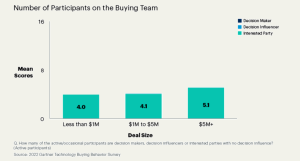
Another 4 to 5 participants are in the buying team as influencers of the decision. Here also counts, the bigger the deal, the more influencers.
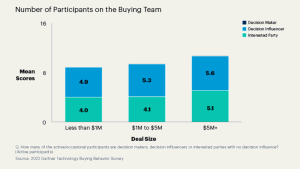
If we add to that the decision makers, then you can see that deals below a million are on average covered by 12 people.
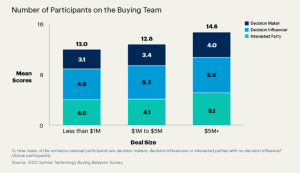
Deals between 1 and 5 million are covered by almost 13 participants, while deals above 5 mio are covered by 14,5 participants. “Buying is a team sport”, as in sports it is not about that single best athlete in the team, it is all about collaboration to achieve the best possible team goal. If you imagine that even a soccer team of 11 people is a challenge, let alone a buying team of more than 12 people. How can big buying teams still achieve “high quality deals”?
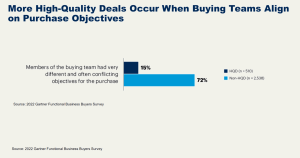
Gartner’s Functional Buyers Survey turned out that more “high quality deals” occur, when buying teams are aligned on purchase objectives. Here you see that 72% of organizations had “low quality deals” and didn’t meet their objectives, because they had conflicting purchase objectives.
This goes back to the earlier point that it is crucial to get the problem statement right in the discovery phase, and to clarify if the statement didn’t change during the buying cycle. Conclusion: if you understand what buyers’ purchase objectives are, then:
- you drive more “high quality deals”
- you accelerate the deal cycle, and
- You reduce purchasing regret after the deal – super important in subscription-business.
Important: based on the buyer’s role in the organization, they can have different objectives.
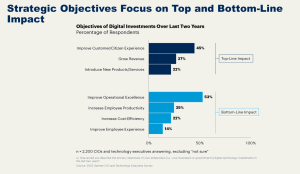
You see here in Gartner’s Technology Executive Survey of 2023, that strategic objectives can be divided into 2 categories:
- Top-line impact like growth, CX, NPI.
- Bottom-line impact like costs, efficiency, productivity, operational excellence and so forth.
Strategic objectives normally drive the purchase objectives. Purchase objectives normally drive the type of decision makers. You need to be aware when selling to top-line buyers – they are customer and financial oriented. While bottom-line buyers are often people with focus on operational efficiency. You need to get these insights of the buying group to tailor your messaging and value proposition.
I often see value props, where you try to address both top-line and bottom-line in one approach. You think you’re smart with that, but buyer’s research says that by combining both, you mostly end up with confusing and conflicting messages. Buying groups don’t like that.
Call to action for sellers:
- Buying groups spend only 17% of their time with vendors, but you can extend that by providing them with materials that will help them in their research, ideally by using Digital Sales Rooms.
- With buying team sizes above 12 persons, you should help them creating consensus as opposed to personalized, conflicting purchase goals.
- For consensus, try to figure out if you are dealing with more top-line or bottom-line buyers, and then tailor your message to them. Don’t combine both, that’s perceived as confusing by buyers.