

How purchase regret is costing you growth and how to prevent it.
Purchase regret. You have that occasionally. Maybe when you try a new product in the supermarket that didn’t taste as good as you thought. It’s part of life, no big deal, you should just accept it. Right?
Well, Gartner dived into this topic and discovered that regret is a real issue because it’s a dominant indicator if there will be renewed or evolved with the product, or not. Gartner did a study where they asked respondents to focus on the largest technology purchase they were involved in.
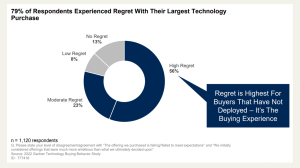
79% of them experienced some level of regret. With that purchase, 56% were high regret. That means that the purchase did not meet their expectations, and they settled for something less than they were originally hoping for. They backed off more ambitious plans.
The 23% moderate regret means that the purchase was partly not meeting expectations and they didn’t settle. In large technology purchases there is in 87% of the cases some level of regret. The respondents that said they had regret, took in their next purchase on average 7 to 10 months longer to buy.
Wow. If you ever wondered, why is it that I have so many opportunities that are for 10 months stuck in the sales cycle? Then this is probably the answer. There is a strong correlation between indecision and stuck in the cycle, with high regret buyers. That is why buying regret is such an important topic to better understand.
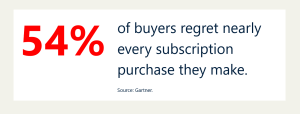
This outcome is not only limited to large purchases. Another Gartner research turned out that 54% of buyers regret nearly every subscription purchase they make. They started hating buying.
The issue with these pessimists –who regret everything- is that they’re much more likely to downgrade their agreements, and they’re also less likely to expand.
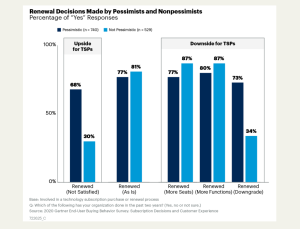
See the right-hand side. On the left hand side you see the only positive thing about pessimists, that is that they are less likely to churn. And the reason is because they hate change. You do need to realize that for achieving your goals, pessimists and purchase regret are real risks. Luckily, your competition is facing the same. To turn this insight in your favor, you need to better understand what the key drivers are of purchase regret.
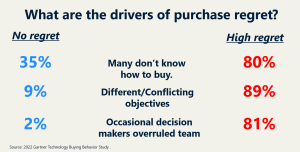
Gartner research found 3 drivers for purchase regret.
- Although you might assume that buyers know how to buy, of the “high regret” customers, 80% of them said that they were delayed because there were steps in the buying process that were a total surprises to them, or that they did not even know that they had to make a purchase for their company. Only 35% said this of the group with no regret.
- Of the “high regret” customers, 89% said that in the buying team they had different and conflicting objectives of what they actually want to solve and what outcomes to expect from the purchase. Against 9% among the “no regret-ers”.
- The decision makers are often not in the room, or not in the room listening to all vendors. In those “high regret” situations, 81% of them said that occasional decision makers overruled the recommendations of the team.
It’s great that you now have a better understanding about what the real drivers are behind purchasing regret. But more important is, what are you going to do about this, to secure your next deal, renewal or expansion?
Based on this research, Gartner provides 3 concrete tips on how to reduce impact of regret on your business.
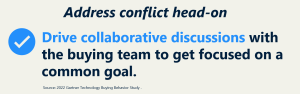
- In a B2B situation, your ideal customer is not a CIO or CFO. They don’t spend their own money, so it is the company. The company’s money is spent by buying teams. Buying teams consist of a lot of people and they all have their own background, thoughts, experiences and preferences. This often leads to conflicts. Tip #1 is to address conflicts straight on.
- Don’t assume that everyone on the buying team agrees on the common goal.
- Don’t contribute to them individually for their own sake, while you’re then in fact contributing to different objectives and conflict
- Instead, in every meeting gain agreement on what that goal is and then reinforce it and make sure your sponsors and leaders are doing the same. Having that discussion will help the companies and it will help you, so that’s the first thing.
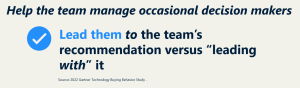
- The second thing has to do with occasional decision makers, who are very often not in meetings. It does not help if they are told what to do. Buying teams should not lead with their recommendations to take over. They would rather lead the occasional decision makers to what the buying team believes is the right direction. Your role is that you help the buying teams with tools, templates or an approach, to lead decision makers to their recommendations.
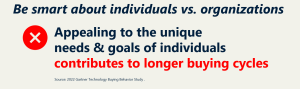
You should always keep in mind in your conversations who you have in front of you? Think about the Triple Metric -what level in the organization, what are their typical KPIs, business or IT-driven? But act smart with that.
Make sure that you’re not going overboard and trying to appeal to the unique needs of an individual, because then you are amplifying the different responsibilities and goals which will only contribute to longer buying cycles. Work the other way around: focus on the common goal and frame that into how that connects to their individual roles and responsibilities but always reinforce that common goal.
Call to action for sellers:
For your success: pessimists and purchase regrets are real risks. Three tips to reduce the impact of purchasing regret:
- Drive collaboration in the buying team to get to common goals
- Don’t tell them what to do, lead them to your solution instead of leading with.
- Don’t tailor your solution to the unique needs of 1 person, that will lead to longer sales cycles, you better focus on your differentiators contributing to a common goal.